

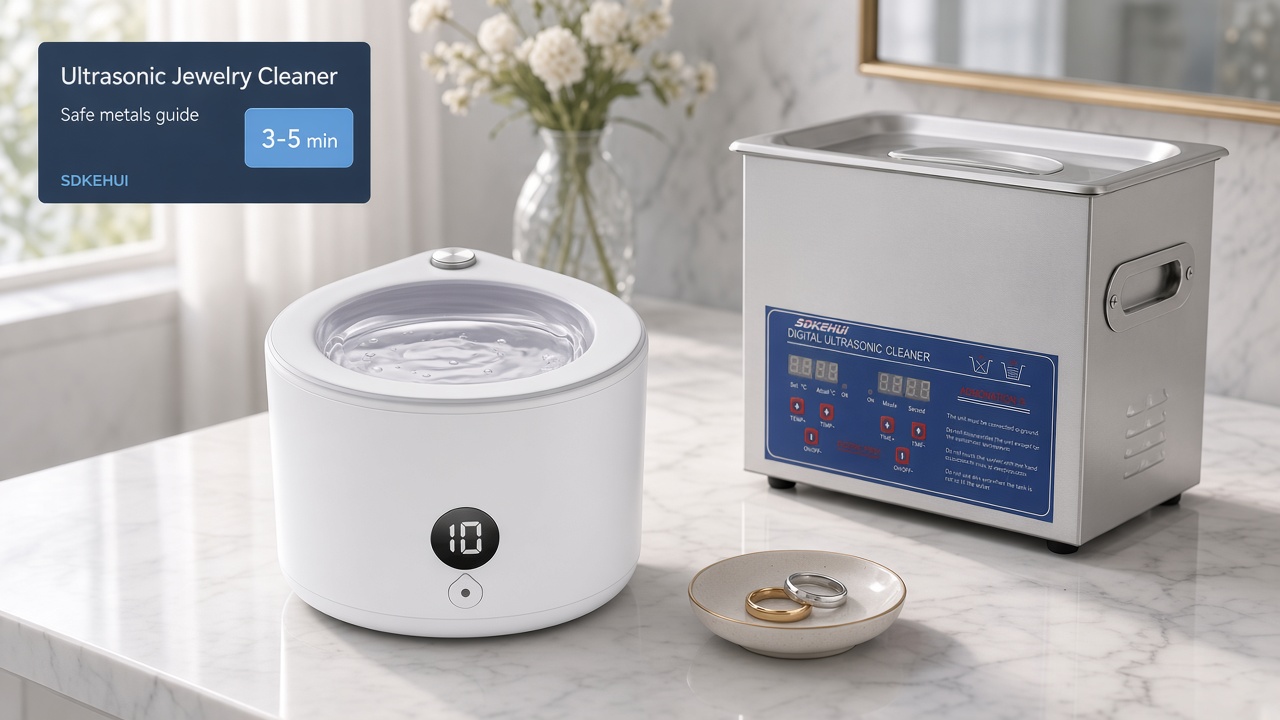
Rings, chains and earrings pick up skin oils, lotion and everyday dust in places a cloth never reaches. An ultrasonic jewelry cleaner uses water motion — not hard scrubbing — to lift that film from crevices and settings. This guide covers which metals usually clean well, which pieces to leave out, and how to run a safe home cycle with SDKEHUI Portable or tank models.
Why ultrasonic cleaning works on jewelry
Inside the tank, a transducer drives the liquid at tens of thousands of cycles per second. Tiny bubbles form and collapse against the metal surface — a process called cavitation. That micro-agitation reaches under prongs, into chain links and around clasp hinges where lotion and soap residue tend to cling.
A soft cloth still matters for a final wipe. Ultrasonic cleaning is best at the sticky film and grit that hide in detail work — the same reason jewelers have used baths for decades. Results depend on the metal, any stones or glue, water quality and cycle time. Always check your piece first.
Safe metals vs skip / use caution
Treat this as practical home guidance, not a jewelry appraisal. When in doubt, ask a jeweler before immersing a valuable or antique piece.
Usually fine (solid pieces)
- Solid gold, silver and stainless steel rings, chains and earrings
- Many solid platinum and titanium pieces with secure settings
- Costume metal without glued stones, if the finish is stable and the clasp sits fully under water
Skip or ask a jeweler first
- Pearls, opals, emerald and other soft / porous stones — water and vibration can stress or dull them
- Glued stones, foil-backed stones and costume pieces with adhesive — glue can loosen
- Loose, worn or hollow settings — vibration may make a weak stone worse
- Antique or thin plating — plating can wear faster in a bath; clean gently by hand if the finish is already thin
- Watches with non-sealed cases, leather straps or battery compartments — keep water out of the movement; metal bracelets alone are a better candidate
If a piece mixes safe metal with an unsafe stone, leave it out of the tank and clean the metal surfaces by hand.
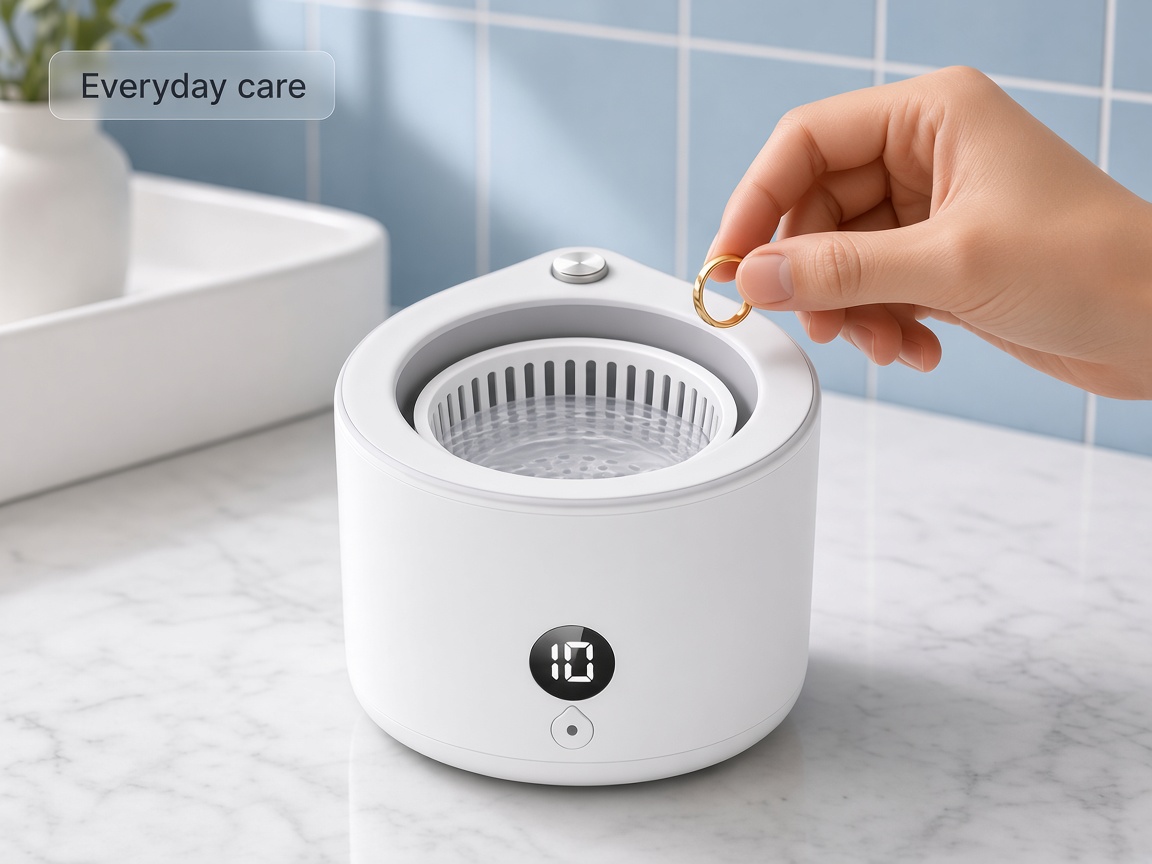
Step-by-step: how to clean rings and small jewelry ultrasonically
Use the basket. Do not drop pieces on the tank floor. Keep hands out of the liquid while the unit runs. Never use gasoline, alcohol, acetone or other flammable solvents.
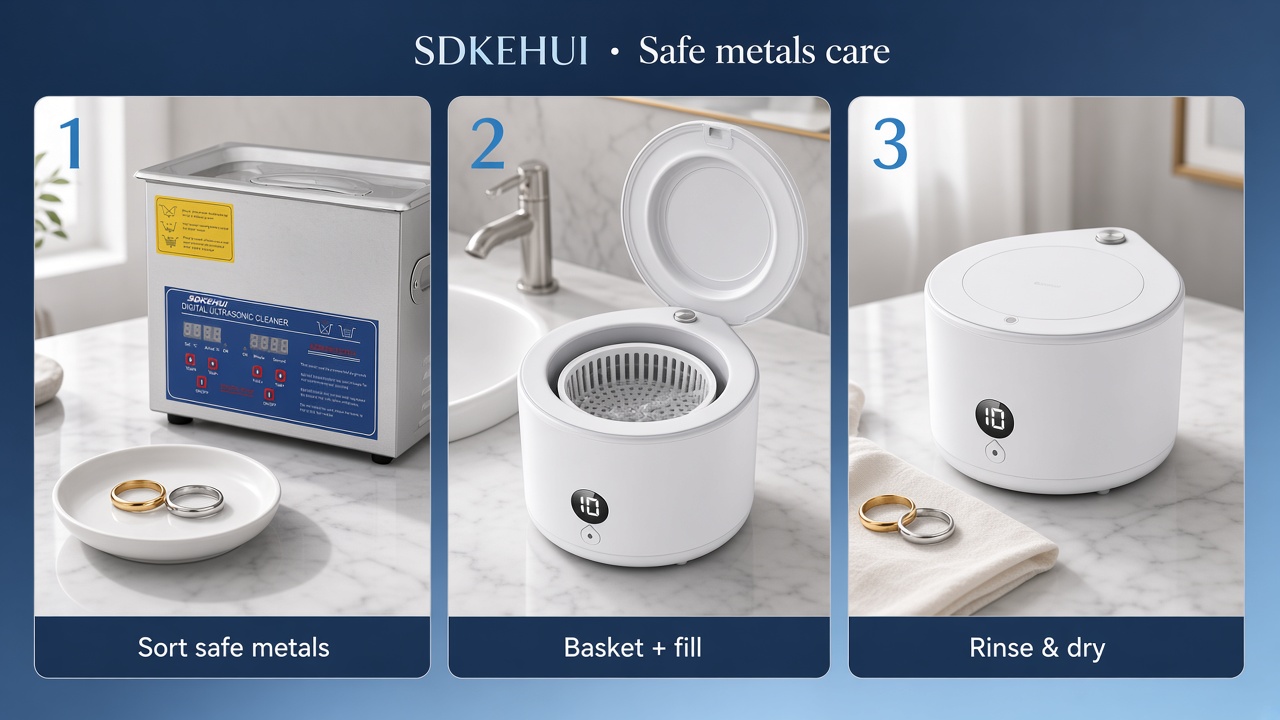
- Sort first. Pull out pearls, soft stones, glued pieces and anything with a loose setting.
- Rinse under tap water. Knock off loose lotion and dust so the bath is not fighting a thick layer of grit.
- Fill to the marked line. For Portable SL-103 / SC-194, clean water is enough for daily film. For Bench / Value tanks, use water plus a cleaning solution made for ultrasonic jewelry or general ultrasonic use — follow the bottle and your manual.
- Load the basket. Spread pieces so they do not tangle or crowd. Fully wet every surface; nothing should sit dry on the rim.
- Set a short cycle. Start mild:
- Rinse in clean water. Lift the basket, rinse pieces thoroughly to remove loosened residue and any solution.
- Dry completely. Pat with a soft lint-free cloth. Air-dry chains flat so links do not stay damp in folds. Store only when dry.
If a ring still looks dull after one short cycle, inspect the setting again before running longer. A second short cycle is safer than one long aggressive run on a delicate piece.
Portable mini vs small tank: which size for jewelry?
Both formats use the same cavitation idea. Capacity and heat are the real differences.
Portable — bathroom shelf / travel
Choose a mini when you mainly clean a few rings, studs or a thin chain beside the sink.
- SDKEHUI SL-103 — 150 ml, 45 kHz, 2 / 3 / 5 / 10 min timers, removable basket. Compact enough for a vanity or carry-on. Also used for retainers and glasses that fit under the fill line.
- SDKEHUI SC-194 — 200 ml, 48 kHz, Quick / Deep / UV Only modes. Slightly more tank room for a small batch of earrings or a denser chain.
Browse both under Portable ultrasonic cleaners.
Small tank — jewelry tray / desk / light workshop
Choose a tank when you clean several pieces at once, want optional heat, or also wash glasses frames, watch bracelets and small metal parts.
- SDKEHUI 3L Bench — 40 kHz, 120 W ultrasonic, 100 W heater, 0–30 min digital timer. Desk-sized footprint for rings, chains and eyeglasses.
- SDKEHUI 6L Value — 40 kHz, 120 W ultrasonic, 200 W heater, 0–30 min timer, side drain. More room for batches or longer bracelets without crowding.
See the full tank range in Ultrasonic tank cleaners (Workshop, Bench, Value).
Rule of thumb: one or two everyday rings → Portable. A jewelry tray’s worth of pieces, or shared use with glasses and small tools → Bench 3L or Value 6L.
FAQ
Can I clean diamond rings in an ultrasonic cleaner?
Many solid-set diamond rings clean well if the stone is secure and there is no glued accent or soft companion stone. Check prongs first. If anything wiggles, skip the bath and see a jeweler.
Do I need special jewelry cleaning solution?
Portable units usually run fine on clean water for light daily film. Tank models often perform better with a jewelry-safe ultrasonic solution diluted per the label. Avoid household bleach, ammonia mixes you have not verified, and any flammable solvent.
How often should I clean jewelry ultrasonically?
For rings you wear every day, a short cycle once a week is enough for most people. Clean sooner after lotion-heavy days or when a setting looks cloudy. Over-running soft or plated pieces does not help — frequency matters less than matching the piece to a safe process.
Soft next step
If you want a sink-side habit for rings and small earrings, start with the SL-103 Portable or SC-194. If you prefer a heated basket for a full tray of jewelry (and the odd glasses or bracelet), look at the 3L Bench or 6L Value.
Orders include free shipping to the US, UK & EU, easy 30-day returns, and a plug matched to your country (US 110 V; UK/EU 220 V).